
BUNGUR (Lagerstroemia speciosa)
Nombre comercial
Bungur
Nombre científico (con autor)
Lagerstroemia speciosa (L.) Pers.
Familia
Lythraceae
Nombres Comunes
Ye-pyinma; Thwa-u; Thwa-mu; Tanbangau; Taman; Tabangao; Tabaek; Shem marutha; Sekre; Queens flower; Pyinma-ni; Pumaruthu; Pu maruthu; Parasabukung; Pantahaun; Pamarauagon; Pamalauagon; Pamalasagon; Nirmarud; Nir-venthekku; Nir maruthu; Nir marutha; Nabulong; Muruta; Mota bondara; Mitla; Mani-maruthu; Mani maruthu; Manaba; Makabalo; Mai-sa-hpong; Kau-ilan; Kamaungni; Kamaung; Kadali; Jarul; Intannin; Hole-dasal; Hani; Gawknguchyamang; Gara saikre; Gara; Einmwe; Eikmwe; Challa hole dasal; Bungor ayer; Bungor; Bondara; Bolashari; Batiladhan; Banang-pulo; Aropag; Ajhar; Agupanga; Adamboe; Abak; Queen of flower; Tabeck (Thailand); Banglang (Vietnam); Jarut (India); Pyinma (Myanmar); Intanin (Thailand); Chuang muu (Thailand); Pride of India; Inthanim nam (Thailand); Tabaek dam (Thailand); Bungur (Indonesia); Gawkng-uchyamang (Myanmar); Tibabah (Sabah); Bongor biru (Sarawak); Bungor raya (Malaysia); Ketangi (Indonesia); Bungur tekuyung (Indonesia); Banaba (Philippines)
Nombres científicos sinónimos (con autores)
Munchausia speciosa L.; Lagerstroemia flos-reginae Retz.
DESCRIPCIÓN DEL ÁRBOL
Descripción botánica
It is a small to medium-sized to large tree up to 40 m tall, 60 to 100 cm in diameter. The bole is commonly short, cylindrical, often fluted near the base, branchless for up to 18 m. The buttresses are inconspicuous, rounded, low and small.
Hábitat natural
Lagerstroemia speciosa is found at low to medium altitudes in secondary forests, especially along rivers.
Distribución natural
It is distributed in South China, Indo-China, Thailand, Myanmar, Malaysia to the Celebes and Philippines.
Existencia de plantaciones?
This species is cultivated within its distribution of origin and also in many other tropical countries.
IDENTIFICACIÓN DE LA MADERA
Descripción anatómica de la madera
Occasionally wood semi-ring porous and/or ring porous. Occasionally tangential diameter of vessel lumina 200 micras or more. Occasionally tangential diameter of vessel lumina 100 micras or less. Vestured pits. Occasionally vessels per mm2 more than 20. Occasio Occasionally paratracheal axial parenchyma scanty and/or vasicentric. Occasionally axial parenchyma aliform. Axial parenchyma confluent. Two cells per parenchyma strand. 3 to 4 cells per parenchyma strand. Occasionally 5 to 8 cells per parenchyma strand. Occasi Rays exclusively uniseriate. Homogeneous rays and/or sub-homogeneous rays (all ray cells procumbent). Occasionally body ray cells procumbent with one row of upright and/or square marginal cells (Kribs-III). Septate fibers present. Fibers with simple to minutely bordered pits.
-
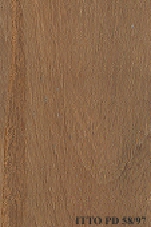 Foto macroscópica de la madera, plano tangencial
-
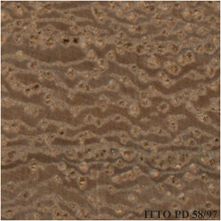 Foto microscópica sección transversal de la madera
Disponibilidad
Status de protección por CITES
Unrestricted
DESCRIPCIÓN GENERAL DE LA MADERA
Olor
It is no distinct taste and odor.
Color
The sapwood is not clearly differentiated from the heartwood, which is reddish brown.
Indice de Color (1= Negro, violeta; 7= Amarillo claro, blanco)
4
Grano
The grain is generally straight, sometimes wavy.
Veta
The texture varies from moderately fine to moderately coarse.
Brillo
The wood is described as moderate in luster.
Durabilidad Natural
The wood is moderately durable to durable when exposed to the weather or in contact with the ground. The heartwood is resistant to very resistant to dry-wood termites.
Indice de Durabilidad Natural (1=Muy alta, 7=Muy baja)
4
Contenido de sílice
Silica Content: It is non-siliceous. Silica Value: 0
Dificultad para impregnar
The heartwood is reported to be resistant to preservative treatment, but the sapwood is readily treatable.
PROPIEDADES FÍSICAS DE LA MADERA
Densidad Básica (Peso anhidro/Vol. saturado) (g/cm³)
0.59
Densidad seca al aire (Peso y volúmen CH12%) (g/cm³)
0.65
Contracción Tangencial Total (Saturado hasta anhidro) (%)
7.8
Contracción Radial Total (Saturado hasta anhidro) (%)
3.8
Defectos por secado
Drying Defects: It is reported that during preliminary air drying surface checks usually develop.
Estabilidad Dimensional (Contracción Total Tangencial %/Contracción Total Radial %)
2.1
PROPIEDADES QUÍMICAS DE LA MADERA
PROPIEDADES MECÁNICAS DE LA MADERA
Resistencia a flexión (Módulo de ruptura) CH12% (kgf/cm²)
988
Rigidez (Módulo de elasticidad) CH12% (kgf/cm²)
104091
Resistencia a la compresión paralela a la fibra CH12% (kgf/cm²)
491
Resistencia a la compresión perpendicular a la fibra CH12% (kgf/cm²)
97
Cizallamiento radial CH12% (kgf/cm²)
111
Dureza Janka (lados) CH12% (kgf)
614
Dureza Janka (extremos) CH12% (kgf)
710
TRABAJABILIDAD
Aserrado
Cutting behavior is reported to be easy to fair.
Corte de chapa rotativa
It is very difficult to slice and peel, even after boiling for 48 hours.
Chapa tranchada
It is very difficult to slice and peel, even after boiling for 48 hours.
Maquinado general
It is easy to machine.
Torneado
30
Taladrado
Boring operations are rather difficult.
Acabado
This species is reported to give a good finish.
Usos Reportados
USOS FINALES (RESUMEN)
HOUSING GENERAL, beams, flooring, frames, FURNITURE AND CABINETS, PLYWOOD AND VENEER, TURNING, cutlery, SPORTS, TOOLS, tool handles, agricultural tools, PACKING, CONTAINERS, cooperage, truck bodies, truck flooring, NAVAL CONSTRUCTION, boats, boat oars, OTHER AND MUSICAL INSTRUMENTS, pencil
VIVIENDA GENERAL
- 10 - Silica in Timbers
vigas
- 11 - Prospect: The wood database
Pisos
- 14 - Handbook of Hardwoods
Marcos
- 16 - Woods of the World
MUEBLES Y GABINETES
- 21 - Tropical timbers of the world. Part III-Southeast Asian and Oceanian Species.
TABLEROS Y CHAPAS
- 25 - Directory of Timber Trade Malaysia
Torneado
- 30 - Embassy of Honduras in Japan
mangos de cuchillos
- 33 - Embassy of Gabon in Japan
IMPLEMENTOS DEPORTIVOS
- 38 - Annual Review and Assessment of the World Timber Situation 1998-ITTO
HERRAMIENTAS
- 42 - Utilización Industrial de Nuevas Especies Forestales en el Perú.
Mangos herramientas
- 43 - Maderas de Bolivia (Características y Usos de 55 Maderas Tropicales)
Mangos agrícolas
- 44 - Atlas of Peruvian Woods
PALLETS_EMBALAJES
- 45 - Recopilación y Análisis de Estudios Tecnológicos de Maderas Peruanas
CONTENEDORES
- 50 - Properties of imported tropical woods
Duelas toneles
- 51 - Recopilacion de propiedades mecanicas de maderas creciendo en Chile
Carrocería de camión
- 53 - Timbers of the New World
Pisos de vagones_contenedores
- 54 - Bulletin of the Government Forest Experiment Station N.157: Identification of Tropical Woods
CONSTRUCCIÓN NAVAL
- 55 - Tropical Timber Atlas of Latin America
Botes
- 56 - Manual de Identificación de Especies Forestales de la Subregión Andina.
Botes_remos
- 60 - Amazonian Timbers, Characteristics and Utilization Volume II; Curuá-Una Experimental Forest Station
Lápiz
- 67 - Maderas latinoamericanas. VIII, Calophyllum brasilense, Couratari panamensis, Dendropanax arboreum y Bombacopsis sessilis
Please Provide Information To View Producer Information