
FAVEIRA AMARGOSA (Vatairea guianensis)
Nombre comercial
Faveira amargosa
Nombre científico (con autor)
Vatairea guianensis Aubl.
Familia
LEGUMINOSAE
Nombres Comunes
Geli Kabbes (Surinam); Geli-kabissi (Surinam); Amargo (Panama); Amargo (Honduras); Yongo (French Guiana); Inkassa (French Guiana); Arisauro (Guyana); Maqui (Colombia); Faveira Amargosa (Brazil); Fava Amargosa (Brazil); Angelim Amargoso (Brazil)
Nombres científicos sinónimos (con autores)
Vuacapua amazonum (Mart. ex Benth.) Kuntze; Vatairea surinamensis Kleinhoonte; Ormosia pacimonensis Spruce ex Benth.; Andira bracteosa Benth.; Andira amazonum Mart. ex Benth.
DESCRIPCIÓN DEL ÁRBOL
Descripción botánica
It is a medium size tree with heights of up to 20 m. The diameter at breast height is commonly 80 cm. The bole is straight, but slightly fluted. This species is reported to present buttresses, sometimes 1 m tall.
Hábitat natural
Vatairea guianensis is reported in temporary inundable areas in the Amazon basin. It is found varzea forests, igapós and along river banks and streams.
Distribución natural
It is widely distributed all over the Amazon basin. In Perú it is found in the departments of Loreto, Ucayali and Madre de Dios.
IDENTIFICACIÓN DE LA MADERA
Descripción anatómica de la madera
Wood diffuse porous. Vessels solitary and in short radial multiples. Tangential diameter of vessel lumina 200 micras or more (large). Vessels per mm2 less than 6 (rare). Simple perforation plates. Vessel-ray pits similar to intervessel pits in size and shape. I Axial parenchyma apparent with the naked eye. Axial parenchyma lozenge-aliform. Axial parenchyma thick lozenge-aliform. Axial parenchyma confluent. Prismatic crystals in chambered axial parenchyma cells and/or in fibers. 3 to 4 cells per parenchyma strand. 4 to 10 rays per mm (medium). Rays 1 to 4 seriate. Homogeneous rays and/or sub-homogeneous rays (all ray cells procumbent). Fibers with simple to minutely bordered pits.
-
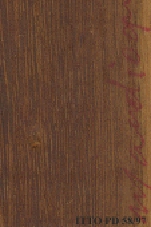 Foto macroscópica de la madera, plano tangencial
-
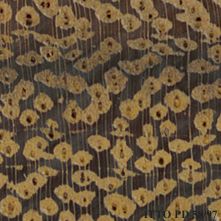 Foto microscópica sección transversal de la madera
Disponibilidad
Status de protección por CITES
Unrestricted
DESCRIPCIÓN GENERAL DE LA MADERA
Olor
It is reported to have a characteristic odor.
Color
The pale brown sapwood is differentiated from the heartwood which is dark yellowish brown when dry.
Indice de Color (1= Negro, violeta; 7= Amarillo claro, blanco)
2
Grano
The grain is straight or interlocked
Veta
The texture is mostly medium to coarse.
Brillo
Luster is usually moderate.
Durabilidad Natural
This species is reported to be moderately durable against decay and termites, but is rated as durable against dry wood insects.
Indice de Durabilidad Natural (1=Muy alta, 7=Muy baja)
3
Dificultad para impregnar
The heartwood is reported to be untreatable.
PROPIEDADES FÍSICAS DE LA MADERA
Densidad Básica (Peso anhidro/Vol. saturado) (g/cm³)
0.59
Densidad seca al aire (Peso y volúmen CH12%) (g/cm³)
0.65
Contracción Tangencial Total (Saturado hasta anhidro) (%)
7.9
Contracción Radial Total (Saturado hasta anhidro) (%)
5.3
Defectos por secado
Ease of Drying: It is rated as moderately difficult to season. Drying Defects: Boxed heart pieces tend to split. Kiln Schedules: Slow drying rates and careful stacking are recommended to reduce degrade.
Estabilidad Dimensional (Contracción Total Tangencial %/Contracción Total Radial %)
1.5
PROPIEDADES QUÍMICAS DE LA MADERA
PROPIEDADES MECÁNICAS DE LA MADERA
Resistencia a flexión (Módulo de ruptura) CH12% (kgf/cm²)
837
Rigidez (Módulo de elasticidad) CH12% (kgf/cm²)
103000
Resistencia a la compresión paralela a la fibra CH12% (kgf/cm²)
489
Cizallamiento radial CH12% (kgf/cm²)
139
Dureza Janka (lados) CH12% (kgf)
633
Dureza Janka (extremos) CH12% (kgf)
635
TRABAJABILIDAD
Corte de chapa rotativa
This species is reported to be interesting for decorative veneer.
Chapa tranchada
This species is reported to be interesting for decorative veneer.
Pérdida de filo_romado
Wood of this species exerts a moderate blunting effect on the cutting tools.
Maquinado general
It is easy to machine.
Clavado
This species is reported to have a good nailing behavior.
Encolado
The timber is reported to glue well.
Acabado
Finishing of this species is reportedly easy.
Usos Reportados
USOS FINALES (RESUMEN)
HOUSING GENERAL, beams, joists, boards, FURNITURE AND CABINETS, common furniture, PLYWOOD AND VENEER, Decorative veneer, TOOLS, tool handles, agricultural tools, PACKING, heavy packing, pallets
VIVIENDA GENERAL
- 10 - Silica in Timbers
vigas
- 11 - Prospect: The wood database
Viguetas
- 12 - Tropical timbers of the world. Part I-Tropical American Species
Tablas
- 13 - Dry kiln schedules for commercial woods. Temperate and tropical. Section III. Latin American (Mexico, Central, and South America) Woods–Conventional Temperatures
MUEBLES Y GABINETES
- 21 - Tropical timbers of the world. Part III-Southeast Asian and Oceanian Species.
Muebles comunes
- 23 - Handbook of Hardwoods
TABLEROS Y CHAPAS
- 25 - Directory of Timber Trade Malaysia
chapa decorativa
- 28 - Ministry of Agriculture, Fisheries & Forest of Fiji
HERRAMIENTAS
- 42 - Utilización Industrial de Nuevas Especies Forestales en el Perú.
Mangos herramientas
- 43 - Maderas de Bolivia (Características y Usos de 55 Maderas Tropicales)
Mangos agrícolas
- 44 - Atlas of Peruvian Woods
PALLETS_EMBALAJES
- 45 - Recopilación y Análisis de Estudios Tecnológicos de Maderas Peruanas
Envase pesado
- 47 - Arvores Brasileiras
Pallets
- 48 - The strength properties of timbers
Please Provide Information To View Producer Information