
PERILLO (Couma macrocarpa)
Nombre comercial
Perillo
Nombre científico (con autor)
Couma macrocarpa Barb. Rodr.
Familia
APOCYNACEAE
Nombres Comunes
Vacahosca; Perillo Negro; Leche Caspi (Perú); Dukaballi; Cumá assú (Brazil); Cuma Assu (Brazil); Avichuri; Ama Apa (Brazil); Popa; Perillo; Pendare; Palo De Vaca; Melkboom; Vaca Hosca; Sorva; Purva; Nienye; Juan Soco; Guaimaro Macho; Couma; Avichure; Milk Tree; Cow Tree
Nombres científicos sinónimos (con autores)
Couma guatemalensis Standl.; Couma caurensis Pittier; Couma capiron Pittier
DESCRIPCIÓN DEL ÁRBOL
Descripción botánica
It is a large tree, with lengths of 30 to 40 m and up to 100 cm of diameter, with no buttresses. It has abundant creamy latex.
Hábitat natural
C. macrocarpa grows usually on well drained lowland sites, in the rain forests of tropical America.
Distribución natural
It is reported from Guatemala, south to Brazil and Perú.
Usos No-maderables
The latex of this species is used in the manufacture of chewing gum. The fruits are edible.
IDENTIFICACIÓN DE LA MADERA
Descripción anatómica de la madera
Wood diffuse porous. Vessels in radial multiples of 2 to 4. Tangential diameter of vessel lumina 150 to 200 micras (medium). Occasionally white deposits in heartwood vessels. Vessels per mm2 6 to 10 (medium). Occasionally vessels per mm2 less than 6. Simple per Apotracheal axial parenchyma diffuse and/or diffuse in aggregates. Axial parenchyma in continuous tangential lines (included in reticulate and scalariform). 5 to 8 cells per parenchyma strand. 4 to 10 rays per mm (medium). Rays commonly 2 seriate. Prismatic crystals in radial alignment in procumbent ray cells (chambered cells). Prismatic crystals in the ray cells. Homogeneous rays and/or sub-homogeneous rays (all ray cells procumbent). Fibers with distinctly bordered pits.
-
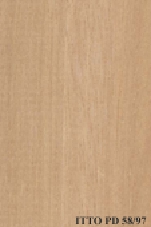 Foto macroscópica de la madera, plano tangencial
-
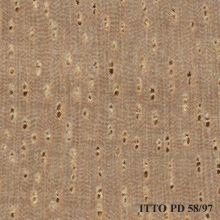 Foto microscópica sección transversal de la madera
Disponibilidad
Status de protección por CITES
Unrestricted
DESCRIPCIÓN GENERAL DE LA MADERA
Olor
Dry wood has no characteristic odor or taste.
Color
The sapwood is not differentiated, the heartwood is reddish yellow when dry.
Grano
The grain is reported to be straight or interlocked.
Veta
The wood is typically medium in texture.
Brillo
The wood surface is described as moderate in luster.
Durabilidad Natural
The heartwood is susceptible to blue staining fungi.
Indice de Durabilidad Natural (1=Muy alta, 7=Muy baja)
5
Dificultad para impregnar
Impregnation of this species is presumably easy.
PROPIEDADES FÍSICAS DE LA MADERA
Densidad Básica (Peso anhidro/Vol. saturado) (g/cm³)
0.56
Densidad seca al aire (Peso y volúmen CH12%) (g/cm³)
0.61
Contracción Tangencial Total (Saturado hasta anhidro) (%)
6.4
Contracción Radial Total (Saturado hasta anhidro) (%)
3.9
Estabilidad Dimensional (Contracción Total Tangencial %/Contracción Total Radial %)
1.6
PROPIEDADES QUÍMICAS DE LA MADERA
PROPIEDADES MECÁNICAS DE LA MADERA
Resistencia a flexión (Módulo de ruptura) CH12% (kgf/cm²)
1150
Resistencia a la compresión paralela a la fibra CH12% (kgf/cm²)
594
Cizallamiento radial CH12% (kgf/cm²)
84
Dureza Janka (lados) CH12% (kgf)
445
Dureza Janka (extremos) CH12% (kgf)
595
TRABAJABILIDAD
Corte de chapa rotativa
This species is interesting for lamination.
Chapa tranchada
This species is interesting for lamination.
Maquinado general
Wood processing is reported to be easy.
Cepillado
It is easy to plane, but difficult when interlocked grain is present in the quarter-sawn surfaces.
Clavado
This species is reported to have a good nailing behavior.
Lijado
Wood of this species is easy to sand.
Acabado
Wood of this species gives a good finish, but it may pose some difficulties on quarter sawn stock.
Usos Reportados
USOS FINALES (RESUMEN)
HOUSING GENERAL, beams, joists, flooring, steps, FURNITURE AND CABINETS, PLYWOOD AND VENEER, PACKING, light packing
VIVIENDA GENERAL
- 10 - Silica in Timbers
vigas
- 11 - Prospect: The wood database
Viguetas
- 12 - Tropical timbers of the world. Part I-Tropical American Species
Pisos
- 14 - Handbook of Hardwoods
Peldaños
- 17 - Tree Conservation Database
MUEBLES Y GABINETES
- 21 - Tropical timbers of the world. Part III-Southeast Asian and Oceanian Species.
TABLEROS Y CHAPAS
- 25 - Directory of Timber Trade Malaysia
PALLETS_EMBALAJES
- 45 - Recopilación y Análisis de Estudios Tecnológicos de Maderas Peruanas
Envase liviano
- 46 - ECUADOR, Inventario y Aprovechamiento de los Bosques del Sur Ecuatoriano
Please Provide Information To View Producer Information