
< Retour TROMPILLO (Guarea guidonia) Version imprimable
TROMPILLO (Guarea guidonia)
Nom commercial
Trompillo
Nom scientifique (avec auteur)
Guarea guidonia (L.) Sleumer
Famille
MELIACEAE
Noms communs (pays)
Trompillo (Bolivia); Cachimbo (Venezuela); Trompillo (Venezuela); Lapati Caspi (Peru); Yantso (Ecuador); Yantsau (Ecuador); Yantsan (Ecuador); Shuina (Ecuador); Villo Villo (Ecuador); Congui`ocho (Ecuador); Tucuta (Ecuador); Cedrillo (Ecuador); Tocota (Ecuador); Sambo Cedro (Colombia); Pialde (Colombia); Requia (Colombia); Piaste (Ecuador); Pico Del Oro; Guaraguao; Guano Blanco; Gitó (Brazil); Fruta De Loro; Cramantree; Cedrophy; Requia (Peru); Carrapeteiro (Brazil); Atauba (Brazil); Trompito; Cramantee; Peito De Pomba (Brazil); Cedrillo Blanco; Cambotata; Acajou; Ata Blanco; Alligator Wood; Wild Akee; Muskwood; American Muskwood; Zambo Cedro (Colombia); Carimbo; Pulgande
Synonymes du nom scientifique (avec auteurs)
Samyda guidonia L.; Guarea trichilioides L.; Guarea puberula Pittier; Guarea multiflora A. Juss.; Guarea aubletii A. Juss.; Guarea alternans C. DC.; Guarea alba C. DC.
DESCRIPTION DE L'ARBRE
Description botanique
This species is reported to be a medium size tree, with heights between 15 to 20 m, up to 25 m. The diameter at breast height is commonly from 40 to 60 cm, or even up to 90 cm. The bole is straight, with small buttresses.
Habitat naturel
Guarea guidonia is a typical species from gallery forests. It is found in secondary forests, along water courses and alluvial sites. Rarely reported in primary forests.
Répartition naturelle
This species is reported to be distributed in the tropical and subtropical forests of Central and South America. In Brazil it is found in until Rio de Janeiro , Sao Paulo and Mato Grosso do Sul. It is also common in the Parana basin.
IDENTIFICATION DU BOIS
Description anatomique du bois
Wood diffuse porous. Vessels solitary and in short radial multiples. Tangential diameter of vessel lumina 150 to 200 micras (medium). Vessels per mm2 10 to 20 (abundant). Occasionally vessels per mm2 less than 6. Simple perforation plates. Vessel-ray pits simil Axial parenchyma confluent. Axial parenchyma oblique and/or sinuous. Prismatic crystals in chambered axial parenchyma cells and/or in fibers. 5 to 8 cells per parenchyma strand. Rays exclusively uniseriate. Silica bodies in the ray cells. Homogeneous rays and/or sub-homogeneous rays (all ray cells procumbent). Septate fibers present. Fibers with simple to minutely bordered pits.
Disponibilité
Statut CITES
Unrestricted
DESCRIPTION GÉNÉRALE DU BOIS
Odeur
It has a pleasant smell.
Teinte
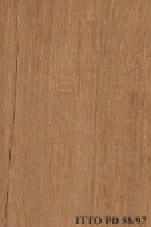
The sapwood is differentiated, it is pale brown, the heartwood is light red when dry.
Index de Teinte (1 = Noir, 7 = Jaune clair)
4
Grain
The grain is mostly straight
Texture
Texture is usually medium to coarse.
Luster
It is reported to be moderate in luster.
Index de durabilité naturelle (1 = Très élevée, 7 = Très faible)
3
Résistance à l'imprégnation
This timber responds poorly to preservative treatment.
PROPRIÉTÉS PHYSIQUES DU BOIS
Densité basale ou gravité spécifique (poids anhydre/vol. saturé) (g/cm³)
0.48
Densité sèche à l'air (poids et volume à 12%TH) (g/cm³)
0.52
Retrait tangentiel total (saturé à 0%TH) (%)
6.3
Retrait radial total (saturé à 0%TH) (%)
3.2
Défauts dus au séchage
Ease of Drying: Drying is rated as rapid. Drying Defects: Slight tendency to checking and cupping. Severe casehardening is also reported.
Calendrier de séchage en séchoir recommandé
UK-E; US-T6-D2
Ratio de stabilité dimensionnelle (% retrait tangentiel total/% retrait radial total)
2.0
PROPRIÉTÉS CHIMIQUES DU BOIS
PROPRIÉTÉS MÉCANIQUES DU BOIS
Résistance à la flexion (module de rupture_MOR) 12%TH (kgf/cm²)
682
Rigidité (module d'élasticité_ MOE) 12%TH (kgf/cm²)
113000
Résistance à la compression parallèle à la fibre 12%TH (kgf/cm²)
442
Résistance à la compression perpendiculaire à la fibre 12%TH (kgf/cm²)
58
Résistance au cisaillement (radial) 12%TH (kgf/cm²)
61
Dureté Janka (latérale) 12%TH (kgf)
399
Dureté Janka (extrémités) 12%TH (kgf)
490
OUVRABILITÉ
Sciage
Sawmilling of this species is reportedly easy.
Usinage
Machining of this species is reported to be easy.
Rabotage
Planing operations are rather easy.
Tournage
30
Perçage
Boring operations are reported to be fair.
Clouage
Nailing properties are good.
Ponçage
It is easy to sand.
Finissage
It has a good finishing.
Applications d'un revêtement
It paints and varnishes well.
Polissage
This species is reported to be easy to polish.
Espèces de substitution
Swietenia sp.
UTILISATIONS
UTILISATIONS FINALES (RÉSUMÉ)
HOUSING GENERAL, fittings, shutter boards, FURNITURE AND CABINETS, PLYWOOD AND VENEER, TURNING, SPORTS, table tennis, PACKING, CONTAINERS, truck bodies, NAVAL CONSTRUCTION, OTHER AND MUSICAL INSTRUMENTS, handicrafts
MEUBLES ET M. DE RANGEMENT
- 10 - Silica in Timbers
Accessoires en bois
- 19 - Silica in Timbers
Volets
- 20 - Prospect: The wood database
MEUBLES ET M. DE RANGEMENT
- 21 - Tropical timbers of the world. Part III-Southeast Asian and Oceanian Species.
PANNEAUX ET PLACAGE
- 25 - Directory of Timber Trade Malaysia
Tournage
- 30 - Embassy of Honduras in Japan
SPORTS
- 38 - Annual Review and Assessment of the World Timber Situation 1998-ITTO
tennis detable
- 41 - Embassy of the Philippines
EMBALLAGE
- 45 - Recopilación y Análisis de Estudios Tecnológicos de Maderas Peruanas
Carros_camion
- 53 - Timbers of the New World
CONSTRUCTION NAVALE
- 55 - Tropical Timber Atlas of Latin America
Artisanat
- 66 - Maderas latinoamericanas. VII. Caracteristicas anatomicas. propiedades fisicomecanicas, de secado, y tratabilidad de la madera juvenil de Cordia alliodora (Ruiz & Pav. Oken.)
Please Provide Information To View Producer Information