
BIBOSI (Ficus insipida)
Nom commercial
Bibosi
Nom scientifique (avec auteur)
Ficus insipida Willd.
Famille
MORACEAE
Noms communs (pays)
Ojé Rosado (Peru); Higuerota (Venezuela); Huacra (Peru); Renaco (Peru); Huito (Peru); Gambo (Ecuador); Chilo (Ecuador); Marañón (Ecuador); Huila (Ecuador); Caucho (Colombia); Matapalo (Colombia); Cauchillo (Colombia); Bibosi Palomo (Bolivia); Bibosi Grande (Bolivia); Higuero (Panama); Matapau (Brazil); Higuerón (Venezuela); Ojé (Peru); Matapalo (Ecuador); Cauchillo (Ecuador); Higuerón (Colombia); Corcho (Bolivia); Ají (Bolivia); Bibosi (Bolivia); Faveiro-Vermelho (Brazil); Caviúna-Rajada (Brazil); Higuerón (Ecuador)
Synonymes du nom scientifique (avec auteurs)
Ficus glabrata Kunth; Ficus anthelmintica Mart.
DESCRIPTION DE L'ARBRE
Description botanique
This species is reported to be a fairly large tree, with heights between 30 to 35 m. The diameter at breast height is commonly from 100 to 150 cm, up to 200 cm, with commercial lengths of 22 m. Ficus trees have abundant latex.
Habitat naturel
Ficus insipida is found in lowlands to medium altitude tropical rain forests in the transition to subtropical.
Répartition naturelle
This species is well represented in the tropical America, it is reported to occur from Panama, Venezuela, Colombia and Brazil, south to Peru and Bolivia.
Usages non ligneux
The latex of Ficus trees is reported to have a vermifuge effect.
IDENTIFICATION DU BOIS
Description anatomique du bois
Wood diffuse porous. Vessels solitary and in short radial multiples. Tangential diameter of vessel lumina 200 micras or more (large). Tyloses common. Vessels per mm2 less than 6 (rare). Simple perforation plates. Vessel-ray pits coarse throughout the ray cell. V Axial parenchyma apparent with the naked eye. Axial parenchyma in thick bands. Prismatic crystals in non-chambered axial parenchyma cells. 5 to 8 cells per parenchyma strand. Axial parenchyma bands more than 3 cells wide. Axial parenchyma bands under 4 per mm. 4 to 10 rays per mm (medium). Larger rays more than 4 seriate. Prismatic crystals in the ray cells. Occasionally heterogeneous rays and/or multiseriate heterogeneous rays. Body ray cells procumbent with mostly 2 to 4 rows of upright and/or square marginal cel Fibers with simple to minutely bordered pits.
-
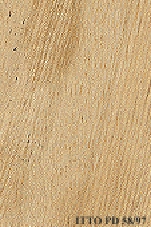 Vue macroscopique du bois (plan tangentiel)
-
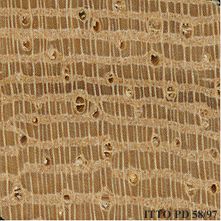 Vue microscopique d'une section transversale du bois
Disponibilité
Statut CITES
Unrestricted
DESCRIPTION GÉNÉRALE DU BOIS
Odeur
It has no distinct odor or taste.
Teinte
The sapwood is not differentiated, the heartwood is pale yellow when dry.
Index de Teinte (1 = Noir, 7 = Jaune clair)
5
Grain
This timber usually has straight or interlocked grain.
Texture
The texture of the wood is medium.
Luster
This species is moderate in luster.
Durabilité naturelle
The wood is non-durable, often liable to decay and insect attack.
Index de durabilité naturelle (1 = Très élevée, 7 = Très faible)
5
Résistance à l'imprégnation
It is easy to preserve, yielding high absorption of oil and water based preservatives.
PROPRIÉTÉS PHYSIQUES DU BOIS
Densité basale ou gravité spécifique (poids anhydre/vol. saturé) (g/cm³)
0.39
Densité sèche à l'air (poids et volume à 12%TH) (g/cm³)
0.42
Retrait tangentiel total (saturé à 0%TH) (%)
7.4
Retrait radial total (saturé à 0%TH) (%)
3.6
Défauts dus au séchage
Ease of Drying: It is reported to air dry rapidly. Drying Defects: Slight tendency to warp or check.
Ratio de stabilité dimensionnelle (% retrait tangentiel total/% retrait radial total)
2.1
PROPRIÉTÉS CHIMIQUES DU BOIS
PROPRIÉTÉS MÉCANIQUES DU BOIS
Résistance à la flexion (module de rupture_MOR) 12%TH (kgf/cm²)
451
Rigidité (module d'élasticité_ MOE) 12%TH (kgf/cm²)
60000
Résistance à la compression parallèle à la fibre 12%TH (kgf/cm²)
325
Dureté Janka (latérale) 12%TH (kgf)
221
OUVRABILITÉ
Sciage
Cutting resistance is generally low.
Coupe de placage de déroulage
This species is reported to be interesting for lamination.
Placage tranche
This species is reported to be interesting for lamination.
Usinage
This species is easy to process, with good finishing.
Rabotage
It is easy to plane.
Tournage
30
Perçage
Boring of this species is reported to be easy.
Ponçage
Sanding of this wood is easy.
UTILISATIONS
UTILISATIONS FINALES (RÉSUMÉ)
HOUSING GENERAL, joists, boards, panelling, fittings, shutter boards, FURNITURE AND CABINETS, cabinets, PLYWOOD AND VENEER, TURNING, PACKING, OTHER AND MUSICAL INSTRUMENTS, shingle, moldings
MEUBLES ET M. DE RANGEMENT
- 10 - Silica in Timbers
Solives
- 12 - Tropical timbers of the world. Part I-Tropical American Species
Planches
- 13 - Dry kiln schedules for commercial woods. Temperate and tropical. Section III. Latin American (Mexico, Central, and South America) Woods–Conventional Temperatures
Panneaux
- 18 - W3TROPICOS Missouri Botanical Garden
Accessoires en bois
- 19 - Silica in Timbers
Volets
- 20 - Prospect: The wood database
MEUBLES ET M. DE RANGEMENT
- 21 - Tropical timbers of the world. Part III-Southeast Asian and Oceanian Species.
Armoires
- 24 - Empire Timbers
PANNEAUX ET PLACAGE
- 25 - Directory of Timber Trade Malaysia
Tournage
- 30 - Embassy of Honduras in Japan
EMBALLAGE
- 45 - Recopilación y Análisis de Estudios Tecnológicos de Maderas Peruanas
Shingles
- 77 - Amazonian Timbers, Characteristics and Utilization Volume I; Tapajós National Forest
Moulures
- 79 - Padronização da Nomenclatura Comercial Brasileira das Madeiras Tropicais Amazônicas, Sugestão
Please Provide Information To View Producer Information