
< Retour CARACOLí, ESPAVE (Anacardium excelsum) Version imprimable
CARACOLí, ESPAVE (Anacardium excelsum)
Nom commercial
Caracolí, Espave
Nom scientifique (avec auteur)
Anacardium excelsum (Bertero & Balb. ex Kunth) Skeels
Famille
ANACARDIACEAE
Noms communs (pays)
Quina; Pomme caju; Mijagao; Maranon; Hoobodia; Espave; E. Rosado; Cajueiro do campos; Caju do campo; Caju da Malta; Cajou; Cajarana; Bouchi-caju; Espavé (Costa Rica); Nariz (Cuba); Mija (Venezuela); Caracoli (Venezuela); Caracoli (Ecuador); Caracolí (Venezuela); Caracolí (Ecuador); Aspave (Colombia); Caracolí (Colombia); Cajuhy (Brazil); Espavel Rosado; Mijao (Venezuela); Marañón De Montaña; Espavé (Panama); Cashu (Brazil); Caschou (Guyana); Caracoli (Colombia); Caju Da Mata (Brazil); Caju Assu (Brazil); Marañón (Ecuador); Espavel Amarillo; Cahu; Cajuvana; Cajueiro Do Campo (Brazil); Gran Cashew; Wild Cashew; Espavel
Synonymes du nom scientifique (avec auteurs)
Rhinocarpus excelsa Bertero & Balb. ex Kunth; Anacardium rhinocarpus DC.
DESCRIPTION DE L'ARBRE
Description botanique
The trees are reported to reach heights of 23 to 30 m, with trunk diameters ranging from 75 to 90 cm. Trees up to 45 m and 150 cm of diameter have also been reported. They develop well-formed and cylindrical boles that are up to two thirds of the height o
Habitat naturel
Anacardium excelsum is one of the largest trees of tropical America, found in gallery forests, generally below elevations of 1,000 m. It is a gregarious species, reportedly grouped in "miguajales" (Venezuela), preferring well drained soils. It is dominan
Répartition naturelle
From southern Honduras south to Ecuador and east to Venezuela. In Venezuela it is sometimes reported to occur in groups up to 45 individuals per hectare.
IDENTIFICATION DU BOIS
Description anatomique du bois
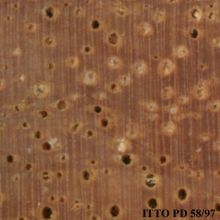
Wood diffuse porous. Vessels solitary and in short radial multiples. Tangential diameter of vessel lumina 200 micras or more (large). Tyloses common. Vessels per mm2 less than 6 (rare). Simple perforation plates. Vessel-ray pits coarse throughout the ray cell. V Paratracheal axial parenchyma scanty and/or vasicentric. Axial parenchyma lozenge-aliform. Non-crystals in axial parenchyma cells. 3 to 4 cells per parenchyma strand. 4 to 10 rays per mm (medium). Rays exclusively uniseriate. Prismatic crystals in the ray cells. Heterogeneous rays and/or multiseriate heterogeneous rays. Body ray cells procumbent with one row of upright and/or square marginal cells (Kribs-III). Non-septate fibers. Fibers with simple to minutely bordered pits.
Disponibilité
Statut CITES
Unrestricted
DESCRIPTION GÉNÉRALE DU BOIS
Odeur
It has no characteristic odor or taste.
Teinte
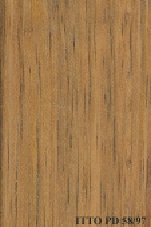
The sapwood is pale brown color. The heartwood gradually changes into yellowish red color.
Index de Teinte (1 = Noir, 7 = Jaune clair)
4
Grain
The wood has straight to interlocked grain. The wood presents attractive vessel lines.
Texture
The texture is medium to coarse.
Luster
The wood has medium to high luster.
Durabilité naturelle
Its resistance to decay varies with type of fungus. Seasoned wood resists termite attack, probably because of gums and oils in the wood which are toxic to insects (but not to humans).
Index de durabilité naturelle (1 = Très élevée, 7 = Très faible)
1
Teneur en silice
Silica Content: This species is reported to have high silica contents which has a moderate blunting effect on the cutting tools. Silica Value: 1
Résistance à l'imprégnation
Heartwood penetration is irregular, but the sapwood is easily treatable.
PROPRIÉTÉS PHYSIQUES DU BOIS
Densité basale ou gravité spécifique (poids anhydre/vol. saturé) (g/cm³)
0.41
Densité sèche à l'air (poids et volume à 12%TH) (g/cm³)
0.44
Retrait tangentiel total (saturé à 0%TH) (%)
5.4
Retrait radial total (saturé à 0%TH) (%)
2.8
Calendrier de séchage en séchoir recommandé
US-T6-D2; UK-E; JUNAC-A
Ratio de stabilité dimensionnelle (% retrait tangentiel total/% retrait radial total)
1.9
PROPRIÉTÉS CHIMIQUES DU BOIS
PROPRIÉTÉS MÉCANIQUES DU BOIS
Résistance à la flexion (module de rupture_MOR) 12%TH (kgf/cm²)
576
Rigidité (module d'élasticité_ MOE) 12%TH (kgf/cm²)
85500
Résistance à la compression parallèle à la fibre 12%TH (kgf/cm²)
331
Résistance au cisaillement (radial) 12%TH (kgf/cm²)
63
Dureté Janka (latérale) 12%TH (kgf)
210
Dureté Janka (extrémités) 12%TH (kgf)
269
OUVRABILITÉ
Sciage
It has low resistance to sawing, but woolly surfaces are reported.
Coupe de placage de déroulage
It interesting for rotary peeling, it does not need thermal treatments.
Placage tranche
It interesting for rotary peeling, it does not need thermal treatments.
Effet d'émoussement
The wood of A. excelsum exerts a severe blunting effect due to the silica content.
Rabotage
The wood is reported to be difficult to plane.
Moulurage
The wood is reported to have good molding characteristics.
Tournage
30
Perçage
Boring properties are reported as fair.
Mortaisage
The wood has good mortising properties.
Clouage
The nail holding properties are fair.
Collage
This species is easy to glue.
Ponçage
The wood is reported to have poor sanding properties.
Polissage
This species is reported to be easy to polish.
Compatibilité avec outils manuels
It behaves well with hand tools.
UTILISATIONS
UTILISATIONS FINALES (RÉSUMÉ)
HOUSING GENERAL, beams, joists, boards, frames, steps, fittings, shutter boards, FURNITURE AND CABINETS, common furniture, cabinets, PLYWOOD AND VENEER, Decorative veneer, TURNING, turned furniture, cutlery, TOOLS, tool handles, agricultural tools, PACKING, light packing, pallets, OTHER AND MUSICAL INSTRUMENTS, door core, cementboard, scale model
MEUBLES ET M. DE RANGEMENT
- 10 - Silica in Timbers
Pouters
- 11 - Prospect: The wood database
Solives
- 12 - Tropical timbers of the world. Part I-Tropical American Species
Planches
- 13 - Dry kiln schedules for commercial woods. Temperate and tropical. Section III. Latin American (Mexico, Central, and South America) Woods–Conventional Temperatures
Cadres
- 16 - Woods of the World
Marches
- 17 - Tree Conservation Database
Accessoires en bois
- 19 - Silica in Timbers
Volets
- 20 - Prospect: The wood database
MEUBLES ET M. DE RANGEMENT
- 21 - Tropical timbers of the world. Part III-Southeast Asian and Oceanian Species.
Meubles ordinaire
- 23 - Handbook of Hardwoods
Armoires
- 24 - Empire Timbers
PANNEAUX ET PLACAGE
- 25 - Directory of Timber Trade Malaysia
Placage tranché
- 28 - Ministry of Agriculture, Fisheries & Forest of Fiji
Tournage
- 30 - Embassy of Honduras in Japan
Ornements
- 32 - Embassy of Cote d`Ivoire in Japan
Manches de couverts
- 33 - Embassy of Gabon in Japan
OUTILS
- 42 - Utilización Industrial de Nuevas Especies Forestales en el Perú.
Outils_manches
- 43 - Maderas de Bolivia (Características y Usos de 55 Maderas Tropicales)
Outils_agric
- 44 - Atlas of Peruvian Woods
EMBALLAGE
- 45 - Recopilación y Análisis de Estudios Tecnológicos de Maderas Peruanas
Embal_léger
- 46 - ECUADOR, Inventario y Aprovechamiento de los Bosques del Sur Ecuatoriano
Emballage, palettes
- 48 - The strength properties of timbers
âme_porte
- 76 - Descripción General y Anatómica de 105 Maderas del Grupo Andino.
Cementboard
- 81 - Madeiras da Amazônia: descrição do lenho de 40 espécies ocorrentes na Floresta Nacional do Tapajós
Maquettes
- 83 - Algunas caracteristicas fisicomecanicas de la madera de tres especies de la cordillera NeoVolcanica
Please Provide Information To View Producer Information