
JARANA AMARELA (Lecythis poiteaui)
Nom commercial
Jarana Amarela
Nom scientifique (avec auteur)
Lecythis poiteaui O. Berg
Famille
Lecythidaceae
Noms communs (pays)
jarana, jarana amarela, matamatá róseo (Brazil); mahot, mahot jaune, meli (paramaka language) (French Guiana); gele bast tétéhoedoe (Surinam).
Synonymes du nom scientifique (avec auteurs)
Chytroma foetida R. Knuth; Eschweilera poiteaui (O. Berg) Nied.; Jugastrum poiteaui (O. Berg) Miers; Lecythis racemiflora Sagot.
DESCRIPTION DE L'ARBRE
Description botanique
Trees, to 35 m tall. Bark with shallow vertical fissures, the outer bark 5 mm thick, the inner bark much thicker, bright yellow. Stems slender, 1.5–2.5 mm diameter, below uppermost leaf, glabrous, green when fresh, often black when dry, inconspicuously angled. Leaves deciduous, flushed just before flowers appear; petioles 5–13 mm long, glabrous, canaliculate; blades narrowly elliptic to elliptic or infrequently oblong, 13-26 x 5-10 cm, chartaceous at anthesis, becoming more coriaceous with maturity, glabrous, the abaxial surface glaucous, usually with rugose papillae, the base obtuse, narrowly decurrent onto petiole, the margins crenulate, with scars left by caducous trichomes, the apex acuminate; venation brochidodromous to weakly eucamptodromous (at least when leaves young), the midrib prominent adaxially, salient abaxially, the secondary veins in 19-26 pairs, often prominulous adaxially and prominent to prominulous abaxially, the tertiary veins inconspicuous, reticulate. Inflorescences terminal or in axils of uppermost leaves, racemose, unbranched, the rachis 12–30 cm long, glabrous, with conspicuous horizontally elongated lenticels, with 2-7 widely spaced flowers. Flowers white, greenish white, or green. Fruits dehiscent, globose to depressed globose, 3.5-8 (excluding operculum) x 5.5-10.5 cm, the calyx-lobes persistent, woody, sometimes reflexed. Brown Seeds 4–6 per fruit, 2.5-3 x 1.5–2.5 cm, the testa less than 1 mm thick, brown, the veins usually impressed; aril basal, barely covering base of seed.
Habitat naturel
Lecythis poiteaui is a canopy tree of non-flooded forest.
Mois de floraison et de fructification
Lecythis poiteaui flowers from Oct to Mar and releases seed from Apr to Jun. It most commonly flowers from the end of the dry season into the rainy season.
Mois de floraison
- Jan.
- Feb.
- Mar.
- Apr.
- May.
- Jun.
- Jul.
- Aug.
- Sep.
- Oct.
- Nov.
- Dec.
Mois de fructification
- Jan.
- Feb.
- Mar.
- Apr.
- May.
- Jun.
- Jul.
- Aug.
- Sep.
- Oct.
- Nov.
- Dec.
Facilité à se régénérer
The fleshy aril is so eagerly sought by monkeys that mature fruits with seeds are difficult to find. This observation suggests that monkeys may play a role in seed dispersal. However, the possibility that bats may disperse the seeds needs to be investigated because these animals eagerly remove the seeds of species of the sapucaia group of Lecythis to eat the aril
Répartition naturelle
Distributed in Surinam, French Guiana, and the Brazilian Amazon from the vicinity of Manaus eastward to near the mouth of the Amazon.
Utilisations locales du bois
Utilisé sous la forme de sciages et bois ronds d'usage général.
IDENTIFICATION DU BOIS
Description anatomique du bois
Growth ring boundaries indistinct or absent. Wood diffuse-porous with simple perforation plates. Intervessel pits alternate, medium, 7 - 10 µm. Vessel-ray pits with distinct borders; similar to intervessel pits in size and shape throughout the ray cell, Vessel-ray pits with much reduced borders to apparently simple: pits rounded or angular and vessel-ray pits with much reduced borders to apparently simple: pits horizontal (scalariform, gash-like) to vertical (palisade), vessel-ray pits of two distinct sizes or types in the same ray cell, vessel-ray pits restricted to marginal rows, less than 5 vessels per square millimetre, 5 - 20 vessels per square millimetre, tyloses common. Fibres with simple to minutely bordered pits. Non-septate fibres present. Fibres very thick-walled. Axial parenchyma in narrow bands or lines up to three cells wide, reticulate. Ray width 1 to 3 cells, ray height > 1 mm, all ray cells procumbent, 4-12/mm. Prismatic crystals present in chambered axial parenchyma cells. Heartwood colour darker than sapwood colour. Heartwood basically brown or shades of brown with streaks.
-
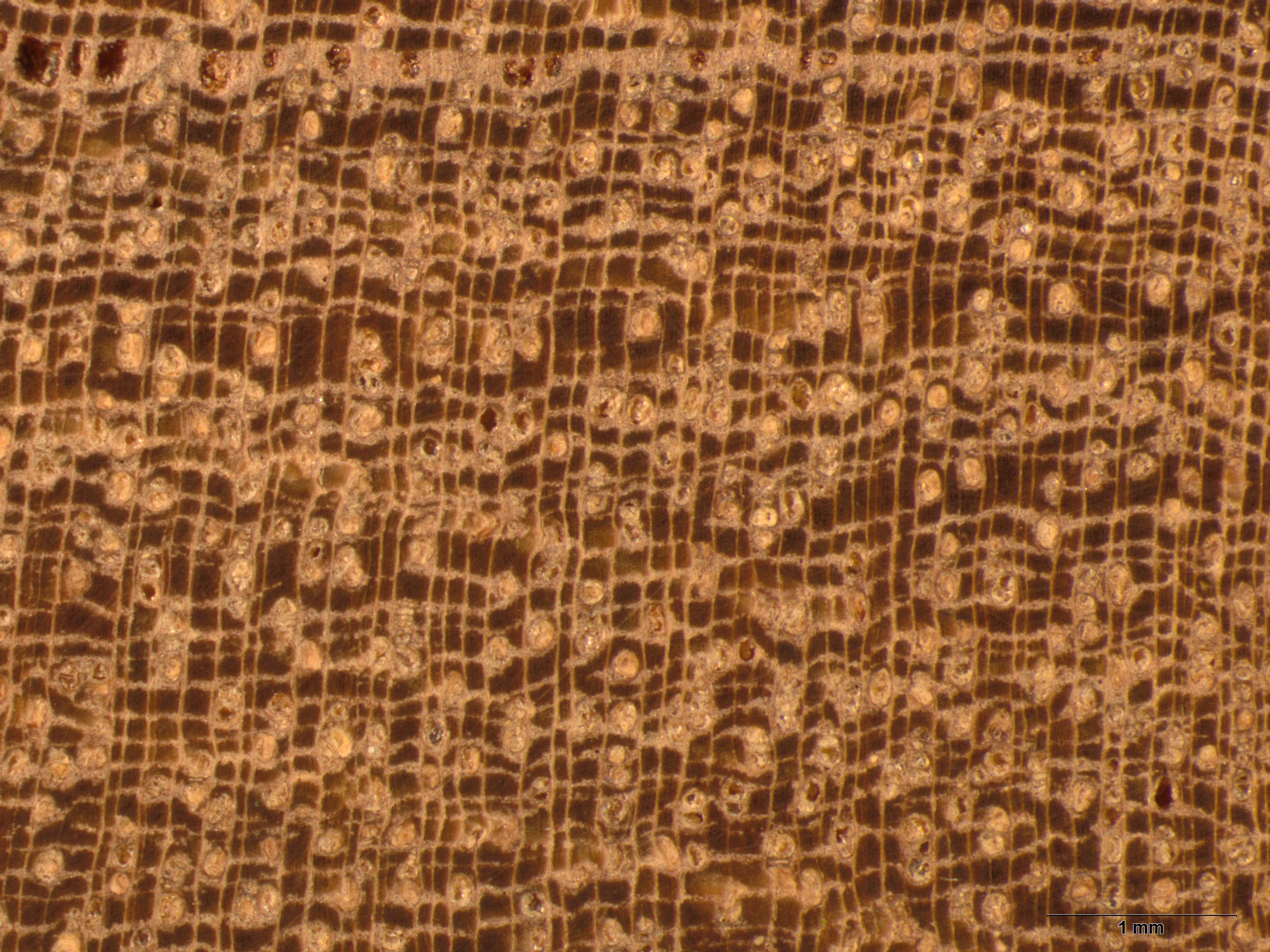 Vue macroscopique du bois (plan transversale)
-
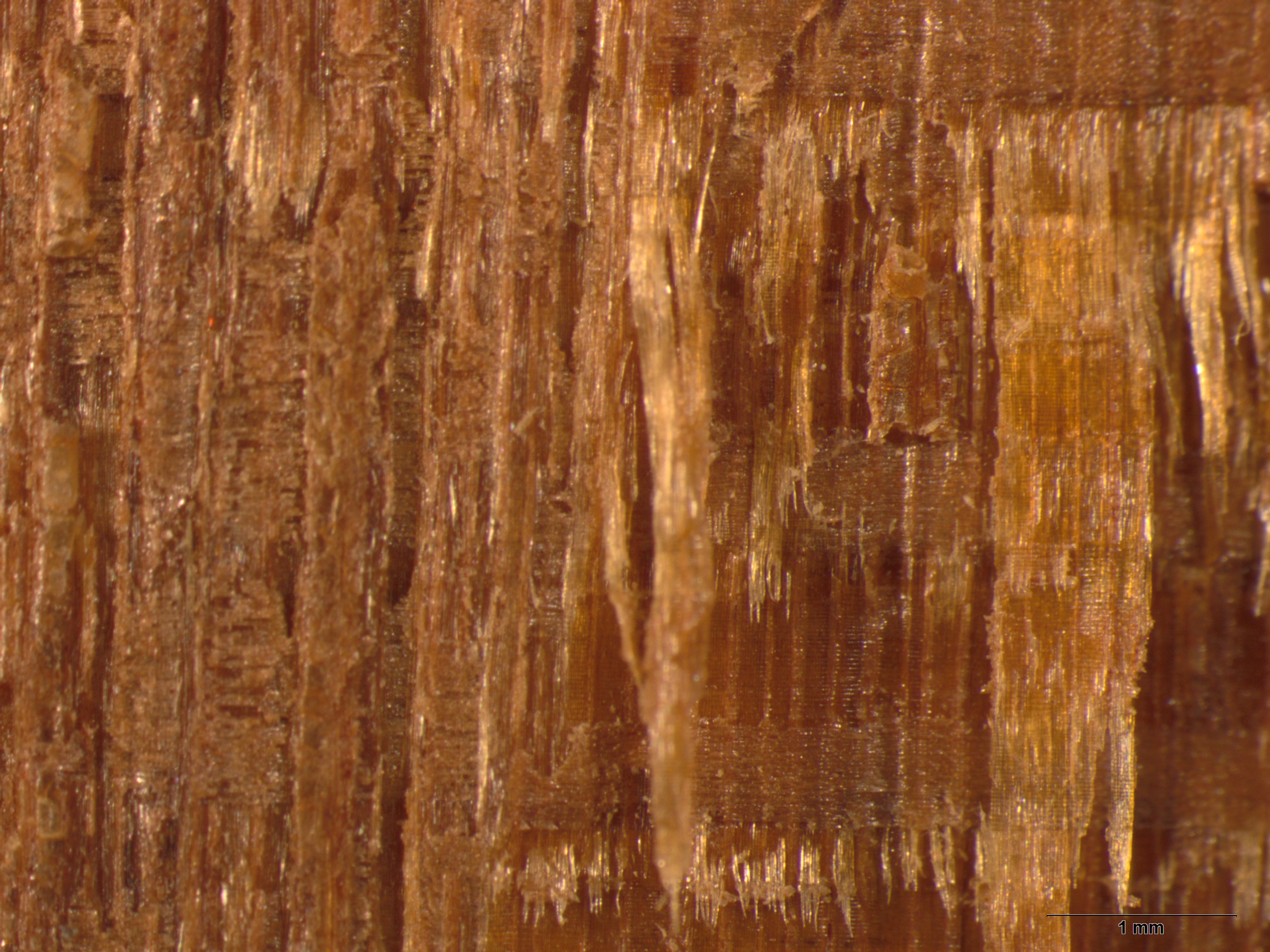 Vue macroscopique du bois (plan radiale)
-
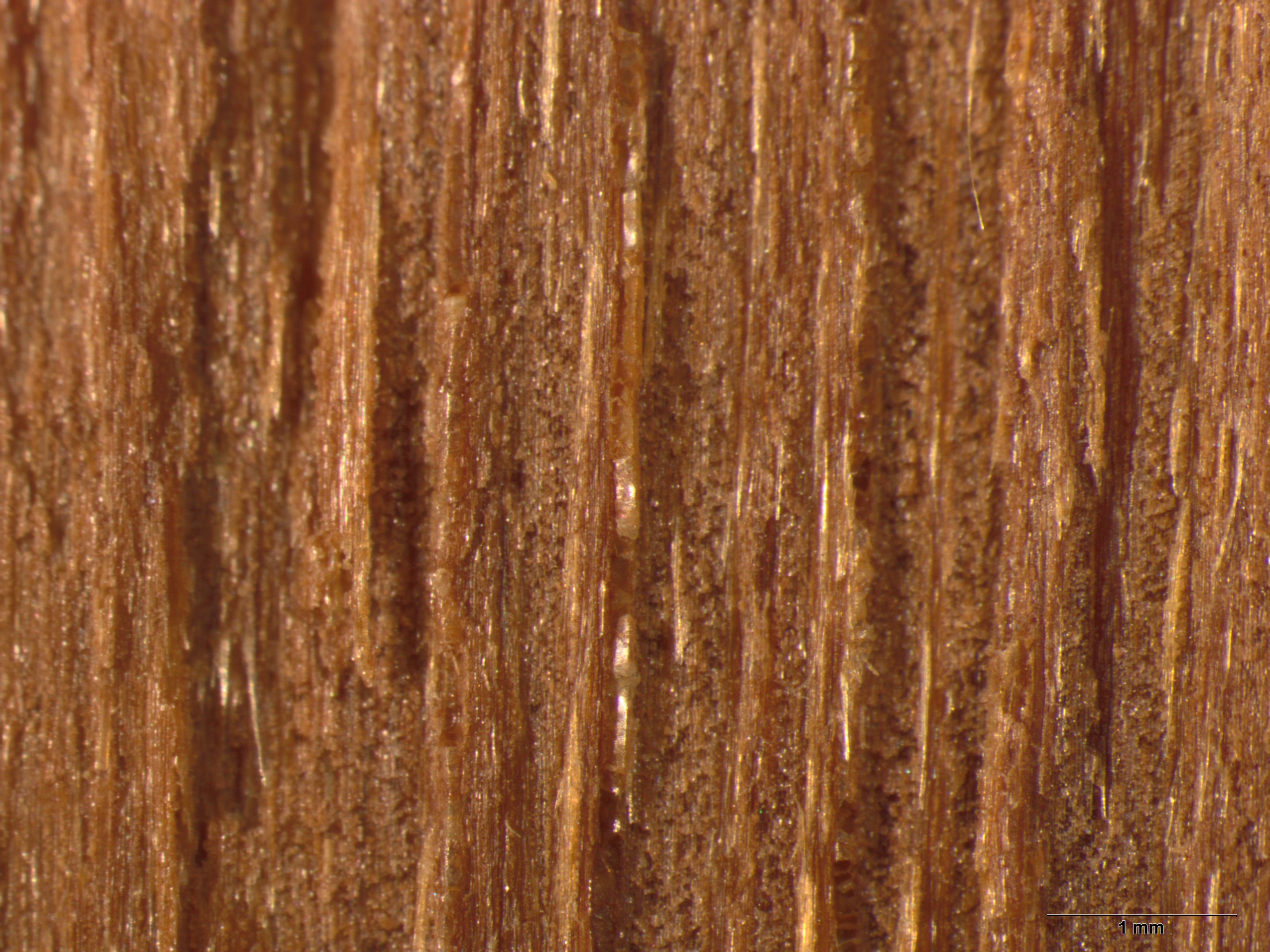 Vue macroscopique du bois (plan tangentiel)
Bibliographie spécialisée (sur ce thème)
- 544 - InsideWood - a web resource for hardwood anatomy. IAWA Journal 32 (2): 199-211.
Disponibilité
Statut CITES
Unrestricted
DESCRIPTION GÉNÉRALE DU BOIS
Index de Teinte (1 = Noir, 7 = Jaune clair)
4
Index de durabilité naturelle (1 = Très élevée, 7 = Très faible)
3
PROPRIÉTÉS PHYSIQUES DU BOIS
Densité basale ou gravité spécifique (poids anhydre/vol. saturé) (g/cm³)
0.86
Densité sèche à l'air (poids et volume à 12%TH) (g/cm³)
1.08
Retrait tangentiel normal (saturé à 12%TH) (%)
7.3
Retrait tangentiel total (saturé à 0%TH) (%)
12.8
Retrait radial normal (saturé à 12%TH) (%)
3.9
Retrait radial total (saturé à 0%TH) (%)
6.8
Défauts dus au séchage
Tendência a empenamentos acentuados, alta incidência de rachaduras (de topo e de superfície). A secagem drástica pode provocar a incidência de rachaduras internas e colapso.
Calendrier de séchage en séchoir recommandé
Madeira de secagem moderada, tanto ao ar como em secadores convencionais. É sugerido um programa com Ti (temperatura inicial) = 40°C, Tf (temperatura final) = 65°C, e PS (potencial de secagem) = 2,2 (500).
Ratio de stabilité dimensionnelle (% retrait tangentiel total/% retrait radial total)
1.9
Bibliographie spécialisée (sur ce thème)
- 502 - Physycal and mechanical properties of the Amazon wood species.
PROPRIÉTÉS CHIMIQUES DU BOIS
PROPRIÉTÉS MÉCANIQUES DU BOIS
Résistance à la flexion (module de rupture_MOR) 12%TH (kgf/cm²)
1360
Rigidité (module d'élasticité_ MOE) 12%TH (kgf/cm²)
150595
Résistance à la compression parallèle à la fibre 12%TH (kgf/cm²)
720
Résistance à la compression perpendiculaire à la fibre 12%TH (kgf/cm²)
212
Résistance au cisaillement (radial) 12%TH (kgf/cm²)
187
Résistance au fendage 12%TH (kgf/m)
278
Dureté Janka (latérale) 12%TH (kgf)
1429
Dureté Janka (extrémités) 12%TH (kgf)
1403
Résistance à l'extraction de clous (latérale) 12%TH (kgf)
174
Résistance à l'extraction de clous (extrémités) 12%TH (kgf)
130
Bibliographie spécialisée (sur ce thème)
- 502 - Physycal and mechanical properties of the Amazon wood species.
OUVRABILITÉ
Rabotage
Bom
Perçage
Bom
Ponçage
Bom a excelente
Bibliographie spécialisée (sur ce thème)
- 502 - Physycal and mechanical properties of the Amazon wood species.
UTILISATIONS
Please Provide Information To View Producer Information