
KAQUI (Diospyros spp)
Nom commercial
Kaqui
Nom scientifique (avec auteur)
Diospyros spp.
Famille
EBENACEAE
Noms communs (pays)
Trayung; Nigerian ebony; Msuini; Mgriti; Kribi ebony; Gaboon ebony; Cameroon ebony; African ebony; Kukuo (Gambia); Nyareti (Nigeria); Kanran (Nigeria); Omenowa (Ghana); Msindi (Tanzania); Mgiriti (Tanzania); Chaperno (Panama); Piriquiteira (Brazil); Carboncito (Venezuela); Bayuca Caspi (Peru); Ébano (Colombia); Kaqui (Bolivia)
DESCRIPTION DE L'ARBRE
Description botanique
The trees are reported to reach heights of 27 m, with trunk diameters ranging from 60 to 80 cm. They develop well-formed and slightly conical boles that are up to 21 m long.
Habitat naturel
Diospyros trees are reported in the transition of subtropical to tropical rain forests in South America. They prefer lowlands to medium altitude areas.
Répartition naturelle
This genus is reported to be common in Panama and northern South American forests.
IDENTIFICATION DU BOIS
Description anatomique du bois
Wood diffuse porous. Vessels solitary and in short radial multiples. Tangential diameter of vessel lumina 150 to 200 micras (medium). Vessel-ray pits similar to intervessel pits in size and shape. Simple perforation plates. Intervessel pits small, 7 micras or Axial parenchyma in continuous tangential lines (included in reticulate and scalariform). 3 to 4 cells per parenchyma strand. Occasionally rays more than 10 per mm (abundant). Rays 1 to 2 seriate. Body ray cells procumbent with over 4 rows of upright and/or square marginal cells (Kribs-I). Fibers with distinctly bordered pits. Occasionally fibers with distinctly bordered pits.
-
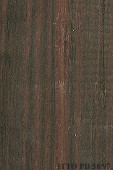 Vue macroscopique du bois (plan tangentiel)
-
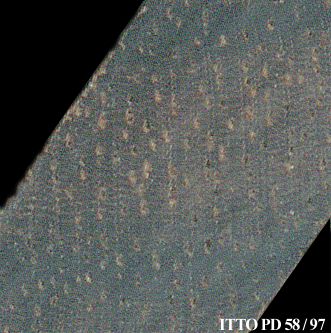 Vue microscopique d'une section transversale du bois
Disponibilité
Statut CITES
CITES III
DESCRIPTION GÉNÉRALE DU BOIS
Teinte
The sapwood is sharply demarcated from the heartwood which is black-brown in color.
Grain
The grain is mostly straight
Texture
Texture of this species is reported to vary from fine to medium.
Index de durabilité naturelle (1 = Très élevée, 7 = Très faible)
2
PROPRIÉTÉS PHYSIQUES DU BOIS
Densité basale ou gravité spécifique (poids anhydre/vol. saturé) (g/cm³)
0.54
Densité sèche à l'air (poids et volume à 12%TH) (g/cm³)
0.59
Retrait tangentiel total (saturé à 0%TH) (%)
11.6
Retrait radial total (saturé à 0%TH) (%)
5.3
Défauts dus au séchage
Ease of Drying: Air seasoning is reported to be rapid. Drying Defects: Risk of end checking and twisting is reported.
Calendrier de séchage en séchoir recommandé
UK-E
Ratio de stabilité dimensionnelle (% retrait tangentiel total/% retrait radial total)
2.2
Calendrier de séchage en séchoir
http://www.tropicaltimber.info/wp-content/uploads/2015/08/KD_British_ENG.pdf
PROPRIÉTÉS CHIMIQUES DU BOIS
PROPRIÉTÉS MÉCANIQUES DU BOIS
Résistance à la flexion (module de rupture_MOR) 12%TH (kgf/cm²)
785
Résistance à la compression parallèle à la fibre 12%TH (kgf/cm²)
472
Dureté Janka (latérale) 12%TH (kgf)
457
OUVRABILITÉ
Sciage
This species is easy to saw.
Tournage
30
Finissage
Wood of this species is easy to finish.
UTILISATIONS
UTILISATIONS FINALES (RÉSUMÉ)
HOUSING GENERAL, boards, fittings, FURNITURE AND CABINETS, cabinets, TURNING
MEUBLES ET M. DE RANGEMENT
- 10 - Silica in Timbers
Planches
- 13 - Dry kiln schedules for commercial woods. Temperate and tropical. Section III. Latin American (Mexico, Central, and South America) Woods–Conventional Temperatures
Accessoires en bois
- 19 - Silica in Timbers
MEUBLES ET M. DE RANGEMENT
- 21 - Tropical timbers of the world. Part III-Southeast Asian and Oceanian Species.
Armoires
- 24 - Empire Timbers
Tournage
- 30 - Embassy of Honduras in Japan
Please Provide Information To View Producer Information