
KERUING (Dipterocarpus hasseltii)
Nom commercial
Keruing
Nom scientifique (avec auteur)
Dipterocarpus hasseltii Blume
Famille
Dipterocarpaceae
Noms communs (pays)
Palawan panau (Philippines); Hasselt's panau (Philippines); Keruing kerukup kechil (Sabah); Keruing laut (Malaysia); Keruing ropol (Malaysia); Jempinang (Indonesia); Dau (Cambodia); Indonesian gurjun (United Kingdom); Keruing (France); Keruwing (Germany); Keruing (Italy); Keruing (Sweden); Kruen (France); Kruen (Italy); Yang (Thailand); Eng (Myanmar); Kanyin (Myanmar); Dau (Vietnam); Gurjun (India); Indonesian gurjun (United States of America); Kruen (Sweden); Keruing bunga (Indonesia); In (Myanmar); Keruing (Indonesia); Panau (Philippines); Hagakhak (Philippines); Keroewing (Netherlands); Keruing (Malaysia); Basilan (Philippines); Bagac (Philippines); Apitong (Philippines); Indonesian keruing (United Kingdom); Indonesian keruing (United States of America)
Synonymes du nom scientifique (avec auteurs)
Dipterocarpus tampurau Korth.; Dipterocarpus subalpinus Foxw.; Dipterocarpus balsamiferus Blume
DESCRIPTION DE L'ARBRE
Description botanique
It is a large tree up to45 m tall. The bole is strongly tapering, up to 150 cm in diameter. The buttresses are flattish. This species is considered an oleo-resin tree.
Habitat naturel
A large tree of lowland dipterocarp forest, cut for keruing timber.
IDENTIFICATION DU BOIS
Description anatomique du bois
Wood diffuse porous. Vessels exclusively solitary (over 90%). Tangential diameter of vessel lumina 200 micras or more (large). Vestured pits. Vessel-ray pits reticulate and/or foraminate. Simple perforation plates. Intervessel pits medium, 7 to 10 micras. Paratracheal axial parenchyma scanty and/or vasicentric. Axial parenchyma aliform. Larger rays more than 4 seriate. Sheath cells. Silica bodies in the ray cells. Body ray cells procumbent with over 4 rows of upright and/or square marginal cells (Kribs-I). Body ray cells procumbent with mostly 2 to 4 rows of upright and/or square marginal ce Fibers with distinctly bordered pits.
-
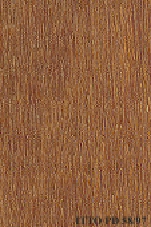 Vue macroscopique du bois (plan tangentiel)
-
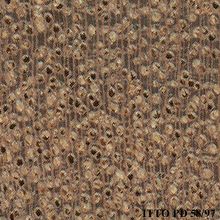 Vue microscopique d'une section transversale du bois
Disponibilité
Statut CITES
Unrestricted
DESCRIPTION GÉNÉRALE DU BOIS
Odeur
It has a distinctive smell of resin.
Teinte
The sapwood is yellowish to grayish-brown and usually distinctly demarcated from the heartwood, which is grayish-brown to red-brown.
Index de Teinte (1 = Noir, 7 = Jaune clair)
4
Grain
The grain is straight, sometimes interlocked.
Texture
The texture varies from moderately coarse to coarse but even.
Durabilité naturelle
Most of the species in the keruing group are rated as moderately durable. The resistance against dry wood insects is poor.
Index de durabilité naturelle (1 = Très élevée, 7 = Très faible)
3
Teneur en silice
Silica Content: This timber is reported to have silica. Silica contents over 0.05% may affect wood processing. Silica Value: 0
PROPRIÉTÉS PHYSIQUES DU BOIS
Densité basale ou gravité spécifique (poids anhydre/vol. saturé) (g/cm³)
0.63
Densité sèche à l'air (poids et volume à 12%TH) (g/cm³)
0.70
Retrait tangentiel total (saturé à 0%TH) (%)
8.5
Retrait radial total (saturé à 0%TH) (%)
3.5
Défauts dus au séchage
Ease of Drying: Air seasoning is reported to be difficult. Drying Defects: It is prone to warping, checking and collapse. Kiln Schedules: Schedule suggested for Brush box. Air seasoning before kiln drying is recommended.
Calendrier de séchage en séchoir recommandé
UK-D; JP-3; US-T3-D2
Ratio de stabilité dimensionnelle (% retrait tangentiel total/% retrait radial total)
2.4
PROPRIÉTÉS CHIMIQUES DU BOIS
PROPRIÉTÉS MÉCANIQUES DU BOIS
Résistance à la flexion (module de rupture_MOR) 12%TH (kgf/cm²)
836
Rigidité (module d'élasticité_ MOE) 12%TH (kgf/cm²)
131808
Résistance à la compression parallèle à la fibre 12%TH (kgf/cm²)
469
Résistance au cisaillement (radial) 12%TH (kgf/cm²)
61
Dureté Janka (latérale) 12%TH (kgf)
427
Dureté Janka (extrémités) 12%TH (kgf)
523
OUVRABILITÉ
Sciage
It is easy to cross cut but slightly difficult to saw. Resin present in wood is reported to clog the saw-teeth.
Coupe de placage de déroulage
Resin patches are usually seen on the surface of the veneer. Preheating is essential for good peeling.
Placage tranche
Resin patches are usually seen on the surface of the veneer. Preheating is essential for good peeling.
Effet d'émoussement
Wood with high silica content quickly blunts saw-teeth.
Rabotage
Planing of this species is reported to be easy.
Perçage
Boring of this species is fair.
Clouage
This species is reported to have a poor nailing behavior.
Collage
The resin interferes with the gluing properties and the species that are too oily are generally not used.
Finissage
This species is reported to be easy to finish. Resin exudation, if present, may difficult finishing.
UTILISATIONS
UTILISATIONS FINALES (RÉSUMÉ)
EXTERIOR GENERAL, crossties, HOUSING GENERAL, flooring, NAVAL CONSTRUCTION
EXTERIOR GENERAL
- 1 - Tabela de resultados de ensaios fisicos e mecanicos
Traverses de chemin de fer
- 8 - Maderas latinoamericas. III, Podocarpus standleyi ,Podocarpus oleifolius, Drims granadensis, Magnolia poasana y Didymopanax pittieri
MEUBLES ET M. DE RANGEMENT
- 10 - Silica in Timbers
Planchers
- 14 - Handbook of Hardwoods
CONSTRUCTION NAVALE
- 55 - Tropical Timber Atlas of Latin America
Please Provide Information To View Producer Information